A Dead French Anthropologist Is Why You Think Egalitarian Polyamory is Difficult

“It’s idealistic to be egalitarian polyamorous.”
I hear this constantly. Interestingly, the pushback rarely is about the polyamory aspect itself; people generally understand loving more than one person. What they find impossible, or unrealistic, is the ability to practice polyamory in an egalitarian way. This skepticism is rooted in a deeply embedded societal assumption: the idea that all human relationships must exist within some sort of hierarchy. We assume someone always has to come first.
But they do not.
To understand why, we have to look at evolutionary anthropology.
When people argue that hierarchy is natural, they usually point to wolves, chickens, or chimpanzees. While it’s true that many animals exist in social dominance hierarchies; the alpha rules through brute force, the weakest are weeded out, and the pack moves on, humans broke that mold long ago.
As anthropologist Christopher Boehm points out, at some point in our evolutionary trajectory, humans actively dismantled ape-like dominance hierarchies. It started roughly 1.8 million years ago with Homo erectus. As the ice age retreated, our ancestors found themselves in the savannah, an environment of immense ecological uncertainty. We had to survive to become the most adaptable species on earth.
We became fully bipedal and built for endurance running, covering massive territories. But with it we also lost our ability to sleep safely in trees. Sleeping on the ground meant vulnerability. We had to huddle together; someone always had to keep watch. Trust became a survival mechanism.
Then our diet shifted. As our brains got larger, our energy needs increased dramatically. The human brain is extremely expensive: it uses a disproportionate amount of the body’s energy. To sustain that, we needed more calorie-dense, nutrient-rich food. Meat provided that. It’s packed with fats, proteins, and micronutrients that are much harder to get in sufficient quantities from wild plants alone. But finding meat was highly unreliable. Some days hunters hit the jackpot; other days our ancestors starved. The only logical solution to that unpredictability was sharing. If I share my surplus with you today, you share yours with me tomorrow. We became a walking insurance system. And a society based on sharing only works if there are rules. If someone takes without giving back, the system collapses. Because of this, humans developed a profound, biological drive for fairness.
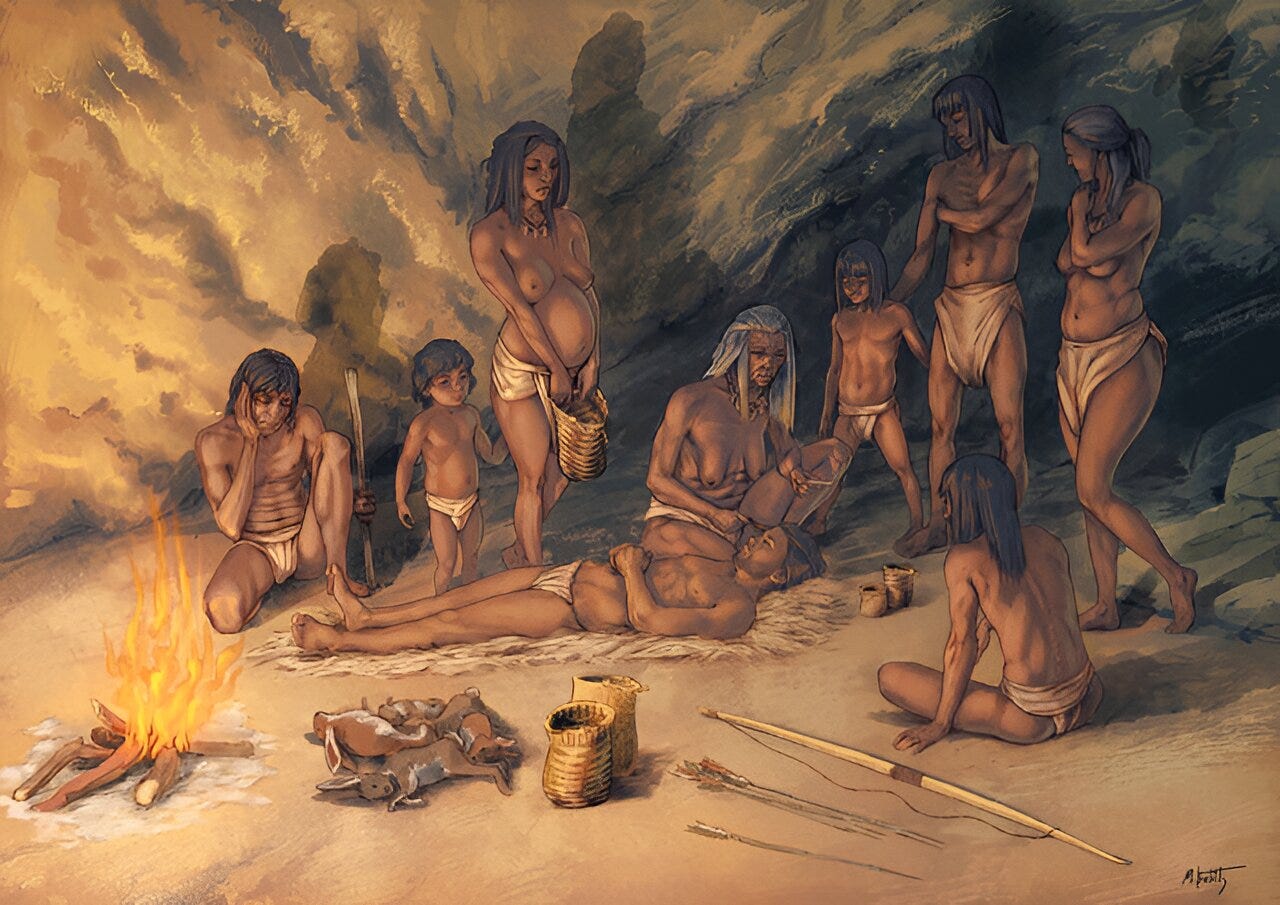
Early humans actually operated on what Boehm calls reverse dominance hierarchies. Instead of the biggest bully ruling the tribe, the tribe worked together to put aggressive, aggrandizing individuals at the bottom. We even have fossilized Neanderthal graves showing individuals who lived long lives with severe disabilities like blindness, broken bones, or deformities. The pack didn’t leave them behind. They fed and protected them for years.
Cooperation and fairness are our actual hallmarks.
So, How Did We Become Hierarchical?
It comes down to scale. Anthropologist Robin Dunbar famously noted that humans can only maintain deep, trust-based relationships with around 150 people. In small foraging bands, punishing a rule-breaker is cheap and effective: you use guilt, shame, and social pressure. But what happens when the agricultural revolution hits and you’re suddenly living in a city of 10,000 strangers? Interpersonal guilt stops working. So humans invented a qualitative leap: the delegation of sanction. We created the State.
Those placed at the top of these complex hierarchies, often initially appointed as chiefs, eventually used their positions to ensure their lineages stayed in power, giving rise to kingdoms and empires. This was branded as the natural order, blessed by divine right through institutions like the Church or Islamic caliphates. For centuries, people accepted their place in this system.
But when European colonizers encountered Indigenous peoples on Turtle Island (North America), those Indigenous populations heavily critiqued the glaring inequality of European civilizations. They questioned if this rigid class system was truly a civilized way to live. This Indigenous critique eventually made its way back across the ocean, deeply influencing Enlightenment thinkers and helping spark the French Revolution.
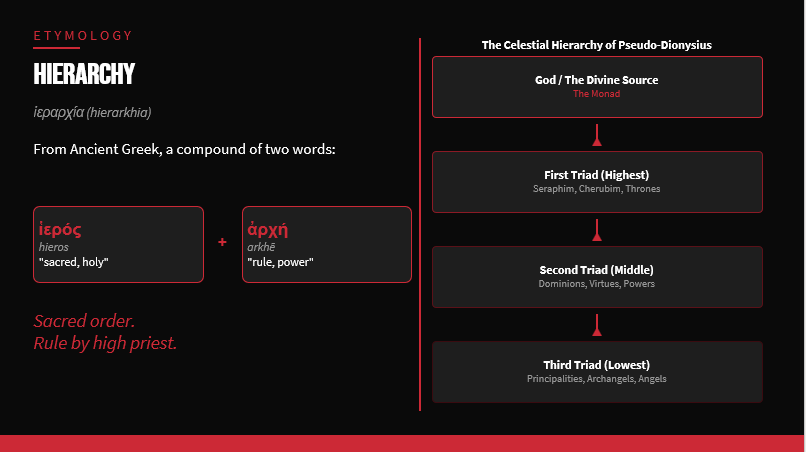
Around this same time, the Scientific Revolution was booming. European scientists needed a way to classify the natural world. They took the word hierarchy a term originally used for a thousand years to describe the sacred, ranked order of priests and applied it to science (e.g., linear hierarchies in biology).
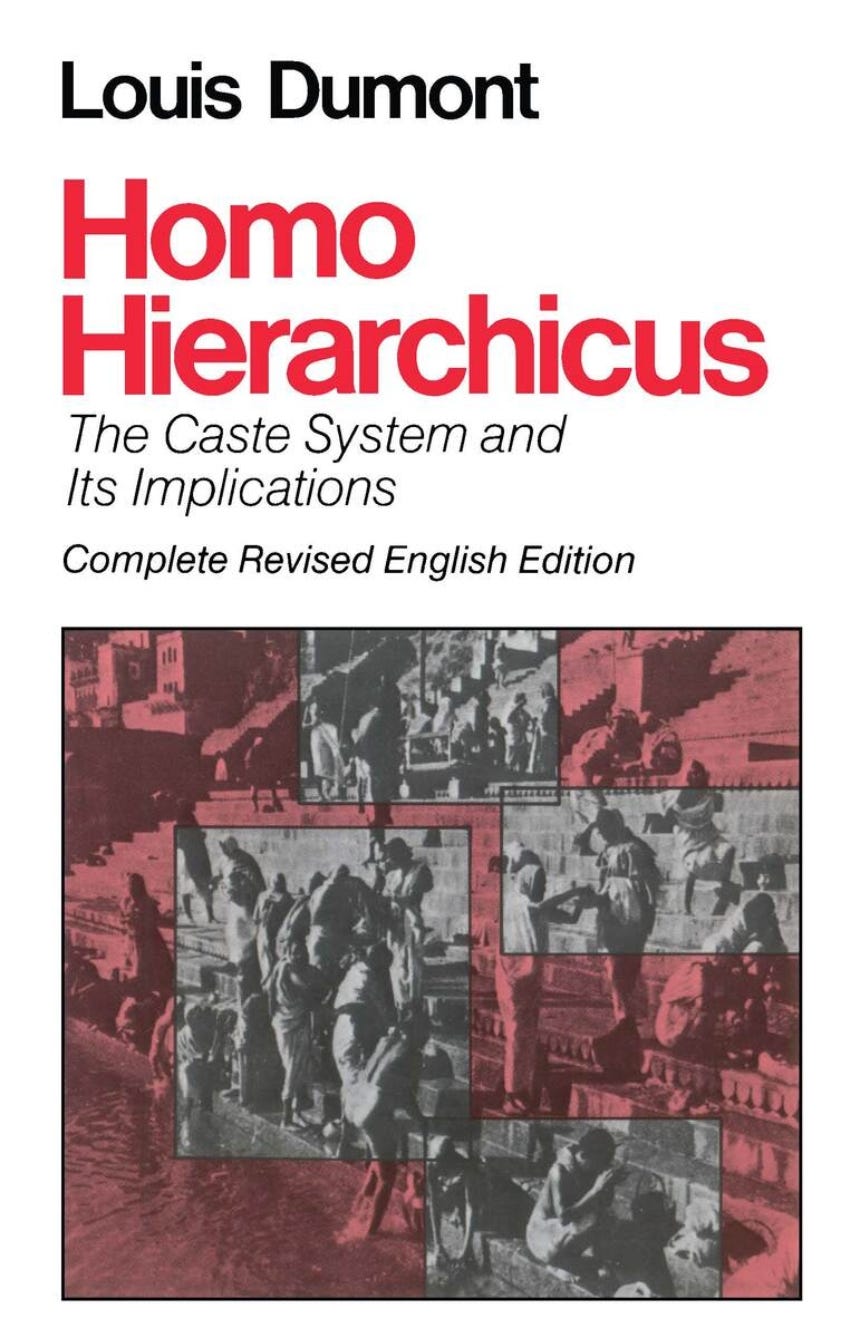
A French Anthropologist named Louis Dumont looked at the chaos of post-war Europe and longed for the stability of the old world. In 1966, he published Homo Hierarchicus, a book that almost single-handedly warped our modern outlook on human organization. After studying the Indian caste system, Dumont argued that society is actually healthier when it is strictly ranked, when everyone simply knows their place.
To sell this deeply conservative ideology to the modern world, Dumont pulled a massive, devastating logical trick: he conflated taxonomic categorization (the neutral grouping of things, like placing sparrows inside the category of birds) with linear ranking (declaring one human life inherently superior to another). By slapping the respectable, scientific-sounding label of hierarchy onto brutal human inequality, Dumont successfully rebranded domination as a natural, inevitable law of the universe. He gave society the vocabulary to justify inequality, and we have been trapped in his intellectual framework ever since.
All this without even mentioning lobsters!
The Resistance Is Ancient and Ongoing
But humanity never fully accepted complex hierarchies in the first place. History is full of people who recognized that domination ruins the human spirit, and they actively built alternatives.
The standard history books love to focus on emperors, massive armies, and civilized states, because the winners write the history and narratives push myth. But there is an entirely different history of human resistance. There were Free-love Zoroastrian sects in ancient Persia that rejected marriage rules and state control. There were ancient farming pirates in the Mediterranean who built self-governing communities on ships, voted democratically, and shared their loot equally. There were massive communities of runaway slaves like the Maroons across the Caribbean who built horizontal, leaderless societies.
As philosopher Niko Kolodny points out, the problem isn’t necessarily that someone has been delegated to organizing a schedule, the problem is rigid hierarchies. It is morally objectionable when a social structure places you below another person in a lasting, unchecked way when they have the power to command you, force you, or demand priority over your needs. It creates a profound sense of inferiority. And nobody, literally nobody, likes feeling inferior, whatever Louis Dumont may think.
Unlearning Hierarchy in Love
This history around hierarchy matters deeply for how we approach polyamory. Because when Morning Glory Zell-Ravenheart coined the term “polyamory” in 1990, it inherited Dumont’s cultural baggage from the start. It began with the assumption of a primary couple who holds power, opening up to trial a secondary partner. Hierarchical polyamory places decision-making authority in the hands of people who aren’t even inside the secondary relationship. Just like the state, it works through delegation of sanction: a primary partner is given the authority to dictate the boundaries, rules, and lifespan of someone else’s relationship.
This is fundamentally unethical. Without full sovereignty over your own relationship, there can be no ongoing consent. Consenting once to be a secondary partner is not enough, consent must be continuous.
Egalitarian polyamory is the radical belief that all partners deserve equal agency and respect. There are many misconceptions about egalitarian polyamory. Egalitarianism does not mean everyone is equal in everything. You can still have preferences. You can live with one partner and not another. You can share finances with one and have a casual, once-a-month dynamic with another. What egalitarianism means is simply you do not remove ongoing agency from any partner. The life of a relationship is dictated only by the people inside it.
Philosopher David Graeber had a concept called prefigurative politics: “Act as if you are already free.” If you want a world without domination, you build it right now, inside the old one. You don’t wait for permission.
You want a world where dominion isn’t the default? Start with yourself. You can’t dismantle the global state alone, but you can change how you engage with the people you love, daily, even hourly. You can refuse to play the pecking-order game.
That’s where the real work begins.
The Next Steps: Doing the Work
The reason so many people struggle with egalitarian polyamory is twofold:
Hierarchical Minds: We have been conditioned by centuries of history to think hierarchically. It literally shapes how our minds process relationships.
Poor Hinge Skills: We lack the practical tools to manage multiple autonomous relationships fairly.
You just read the theory. You understand why hierarchy was never supposed to govern your relationships. But understanding why is only half the battle.
Society never taught you how to relate healthily. Not in school. Not at home. Not anywhere. You were handed a pecking order and told this was love.
Egalitarian polyamory asks you to do something you were never given the tools for: and that’s exactly why most people fail at it. Not because they don’t want it. Because they don’t know how.
We hope to change that.
Hinge Skills is the first workshop of its kind: built entirely around the practical tools you need to manage multiple relationships with fairness, full autonomy, and zero domination. No more theory. Just the skills nobody ever taught you.
Paid subscribers get first access and discounted pricing.