Is Anyone on the Left Pure Enough?

Just had an epiphany while replying to someone in the comments on my Facebook feed. Purity testing is one of the left’s most self-destructive habits. It breeds infighting, cancel/callout culture, and an atmosphere so toxic that people already in the movement don’t feel safe to express themselves genuinely, and people considering joining leftist movements don’t bother. And until we reckon honestly with why it keeps happening, we will keep losing.
There are so many reasons for the emergence of purity culture in the left. One is the literal legacy of Puritanism. Many early figures in American labor and proto-socialist movements came from families and regions influenced by Puritanism, even if they were no longer religious in the 17th-century sense. People who moved away from formal Puritan beliefs helped build some of the first left-leaning movements in the United States, including abolitionists such as Theodore Parker and Ralph Waldo Emerson and later progressive reformers involved in settlement-house work and labor organizing. Even as these movements became more secular, they carried forward key features of Puritan culture: strict moral discipline, communal oversight, and forms of accountability that surveilled and policed behavior.
Colonial culture itself is a coercive domination culture. Many leftists change ideologically from their families worldview but don't unlearn how to be in relation with people.

We've done a great job of teaching consciousness around social inequity, but not how to be in community with each other: to tolerate difference, to disagree without annihilating. The internet amplifies discord, obscures nuance, and rewards performativity over the kind of slow, sustained work that real organizing actually requires.
But I think another reason, which I haven't explored much until now, is how leftists define leftism.
The word left comes from the seating arrangement during the French Revolution. Those who supported popular sovereignty and social change sat to the left of the assembly; those who supported the monarchy and the old order sat to the right.

Because the French Revolution predates the Industrial Revolution by just decades, it shaped the political terrain that followed it; ‘left’ became increasingly associated with anti-capitalism as that struggle became the defining axis of modern politics.
That remains, in my view, its essential core. I define leftism at its most basic as a commitment to anti-capitalism rooted in socialist traditions since Marx (Communist Manifesto, 1848) and, drawing on Bobbio’s Left and Right, opposition to social hierarchy through greater equity. Those are political positions about how power is structured in society. That’s where I stand.
But that’s not the operating definition for everyone who calls themselves left.
For a lot of people, when you drill down, leftism isn’t primarily a political project with a singular objective aim at it’s core. It’s a moral identity. Being leftist to many means being a good person, in contrast to people on the right, who leftists tend to characterize as selfish, frightened of difference, and hungry for power. And that’s where the issue arises. Because the moment leftism equals goodness, we immediately have to answer: what does good mean? And that is deeply, irreducibly subjective.
If you think veganism is what makes someone good, then every leftist should be vegan.
If you think masking in public at all times is what makes someone good, then leftism requires masking.
If you think AI is bad, then a good leftist is categorically anti-AI.
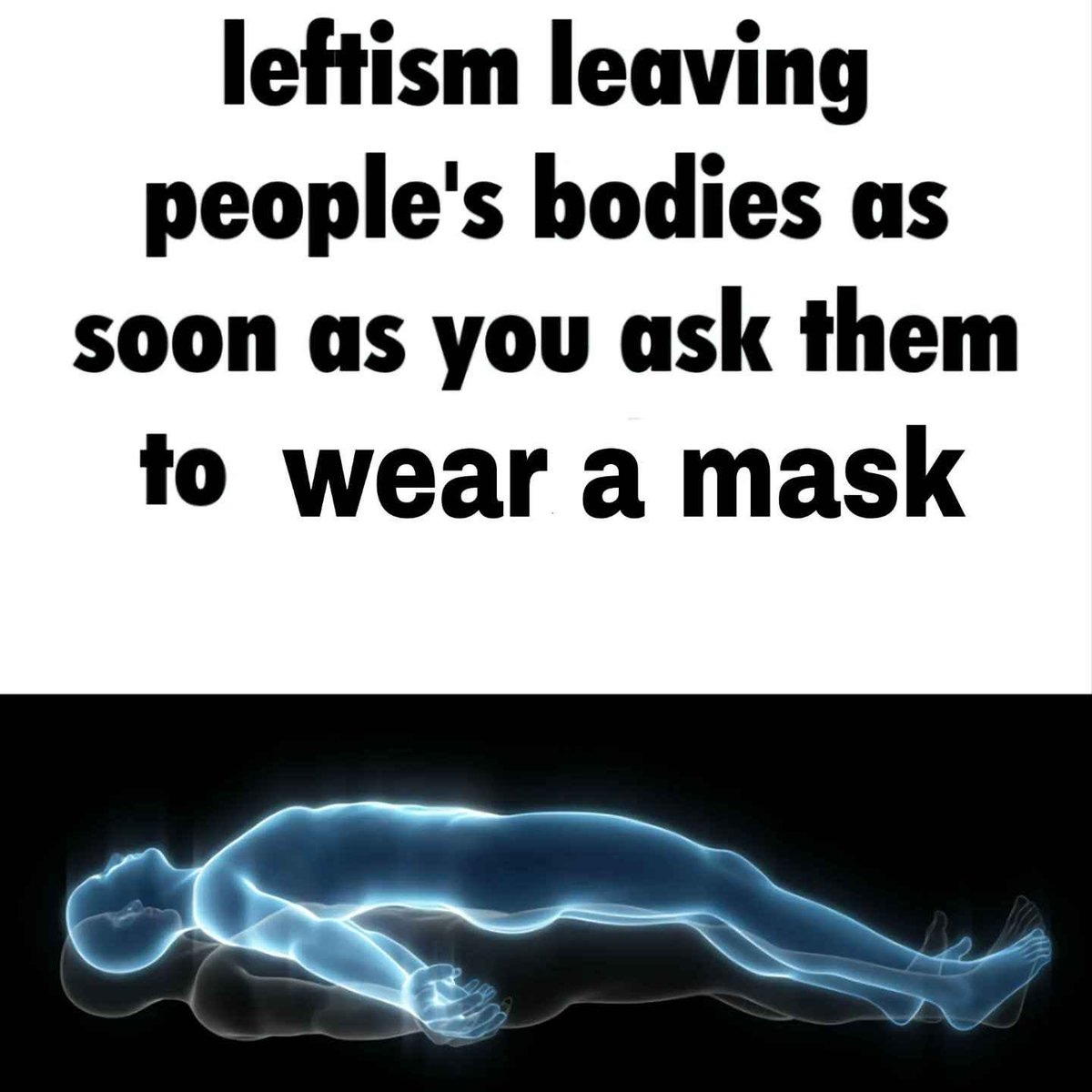
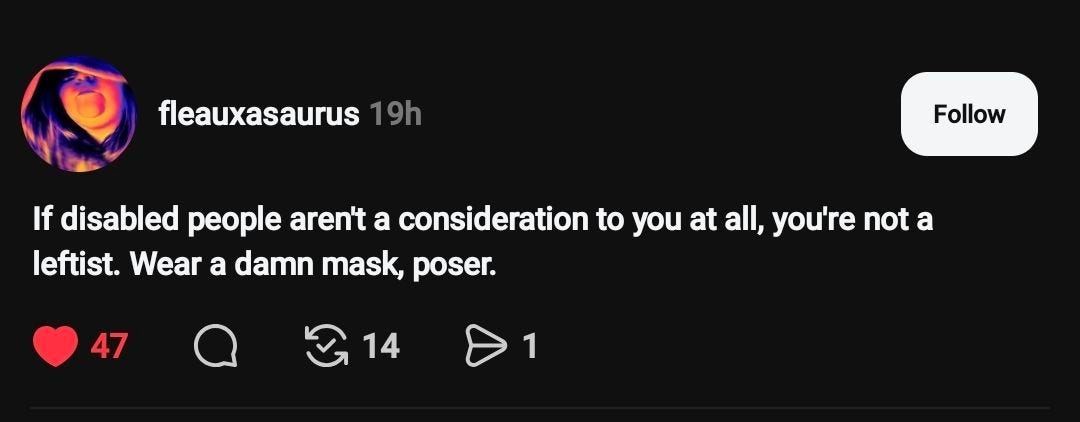
These are real positions many puritan leftists hold, and it surprises your average person because of how extreme and rigid they can sound. But live in a progressive city like Toronto, where I live, or Portland, or spend enough time in online leftist spaces where the chronically online often flood conversations, and you’ll see these views expressed very loudly and aggressively. I don’t always mask in public, and I’ve been called a centrist because of it. When good equals left and bad equals right, disagreement turns into labeling. Instead of engaging the argument, people start assigning identities like liberal or centrist to anyone who doesn’t meet their personal standard of good.
Each of those positions might sound extreme in isolation, but they follow logically from the premise. If leftism equals goodness, then whatever you personally believe constitutes goodness, leftism must require it. The specific content shifts from person to person, and that is exactly the problem. It produces an infinite series of litmus tests, each one generated by someone’s private moral vision, each one treated as a non-negotiable condition of leftist belonging.
There’s another problem inside that logic. If leftism equals being a good person, then the reverse also starts to follow: whatever I do must be good because I am a leftist. At that point, criticism stops feeling like political disagreement and starts feeling like an attack on your identity.
That produces leftist movements full of defensive people, because there is suddenly a lot at stake in being seen as morally correct. People begin scanning each other for mistakes, not to build a stronger community, but to shift attention away from themselves. It creates a toxic echo chamber, and movements trapped in loops like that can’t grow because they’re constantly suppressing each other.
When leftism becomes a personality test instead of a political project, it stops being a vehicle for collective transformation and becomes a sorting mechanism for social belonging. The question stops being, “Are you committed to dismantling capitalism and social hierarchies?” and instead, ACAB leftists become police officers at a moral checkpoint, interrogating, “Are you being a good person?” Those are completely different questions, and they lead to completely different consequences. One builds movements. The other builds walls.
And the deepest irony is who gets hurt most by purity politics: the very people the left claims to center and care for. Poor workers, immigrants, and working class people don’t feel welcome in a movement that demands ideological fluency before it offers solidarity. When you’re more concerned with how socially conscious a struggling worker is than with the conditions they’re actually struggling under, you’ve lost the plot entirely.
A lot of this traces back to the 1990s, when identity politics began replacing class analysis rather than working alongside it. The left started speaking an exclusionary language that felt increasingly distant from the everyday material realities of working class life.
And when people feel judged rather than supported when they’re in need, they go somewhere else for help. It shouldn’t surprise anyone that some of those people found a warmer reception on the right. That’s not a failure of the working class. It’s a failure of a left so absorbed in its own internal performance that it no longer speaks to the people it’s supposedly fighting for.
I’ve spent most of my life in activist circles, and I carry no illusions that being a leftist makes someone a good person. I’ve met many leftists that I think are genuinely terrible people. I’ve worked with them anyway, because the cause is larger than my personal feelings about the individuals involved. That’s just what political organizing requires. Participating in cancel or call-out culture isn’t a substitute for organizing against institutions and structures of power. It can feel like action, but it doesn’t replace the harder work of building movements capable of changing material conditions. You build coalitions with people you wouldn’t choose as friends.
I’m an anarchist but I’ll work with socialists, Marxists, Trotskyists, and council communists. Hell, I won’t even judge someone who claims a conservative ideology as long as they hate billionaires. Differences in theoretical beliefs and strategy don’t have to be breaking points.
This past Monday, April 13, 2026, I concluded my job as the social media manager for Canada’s socialist party, the NDP in a federal election campaign. A good friend of mine worked for the Green Party, and on election night both our campaigns partied together.

And I’ll learn from leftists in history who were, by many measures, shitty people. Many Black Panther Party members were deeply sexist and homophobic. That was genuinely difficult for me to make sense of when I first encountered this fact as a teenager. But it doesn’t erase their organizational brilliance or the concrete gains they made under brutal racial conditions. It means learning from their tactics, honoring their achievements, and holding them accountable, all at the same time. We are capable of doing more than one thing at once. Moral complexity is not a reason to abandon historical analysis. It’s a reason to sharpen it.
The fact that someone caused harm doesn’t cancel what they built, and what they built doesn’t excuse the harm.
Recently I had to once again apply this principle when my hero Noam Chomsky appeared in the Epstein files, and César Chávez was revealed to be a rapist. I wrote about the former reckoning here: Manufacturing Consent, Ignoring Conduct: The Chomsky-Epstein Connection.
I had a follower on my Facebook page ask when I posted my first draft of this polemic “how can someone who's sexist and homophobic be a leftist if leftism is anti-hierarchal”. To which I answered: sexism and homophobia are absolutely forms of social hierarchy, so yes, they contradict the principles of leftism. But that doesn’t mean everyone who holds sexist or homophobic views automatically ceases to be a leftist in every political sense.
Part of the confusion is that leftism operates on more than one level. What I’d call tier-one leftism is anti-capitalism. That’s relatively straightforward to identify. If someone opposes a system where a small class owns the means of production and extracts profit from the labour of those they exploit, they’re operating within a left political framework.
Tier-two leftism is the dismantling of social hierarchies beyond the economic sphere: patriarchy, racism, homophobia, colonial power structures, and so on. That’s far more contested terrain, and movements and individuals don’t arrive at full consciousness about it all at once.
Fidel Castro is an example. He led one of the most significant anti-capitalist revolutions of the twentieth century and reorganized Cuban society around socialist principles. At the same time, the Cuban state persecuted gay people well into the 1970s. That homophobia was wrong and it caused real harm. But it reflected the limits of the prevailing social consciousness.
So it’s reasonable to hold both things at once. Castro was a major leftist political figure, and he upheld harmful hierarchies in other domains that deserve criticism. Those two things can coexist.
If we define leftism as requiring perfect alignment across every social justice axis before someone qualifies, then virtually no historical left movement makes the cut.
A clearer way to frame it is this: sexism and homophobia contradict leftist principles, but they don’t automatically erase someone’s left political alignment. What they reveal is where the work of dismantling hierarchy is still incomplete. And that applies to all of us. We are all still works in progress, still unlearning the conditioning we were indoctrinated into by this system.
And that is an uncomfortable truth for many people particularly in North America to accept: being imperfect. Perfectionism is colonizer culture, and puritanism too, because of the binary belief of saint vs sinner, which leaves no space for people to be works in progress who are still learning and growing.
This also connects to something I’ve noticed comparing political cultures. I grew up in my teens in the Netherlands, where the left is far less puritanical than its North American counterpart. Dutch political culture places a high value on directness and genuine debate. Disagreement is treated as a normal part of political life rather than a threat to belonging. Anglophone political culture tends to work in the opposite direction. People are often conflict-averse in person but coercive about where others are expected to land ideologically. There’s a strong expectation that you should already hold the correct positions before speaking, and that you should be performing them consistently and without visible imperfection. A political conversation is not a space where people refine ideas together. Instead it is a space where people demonstrate alignment. Once political participation operates like performance rather than real engagement, you’ve entered the realm of puritanism. And that is the colonizer culture alive and well breathing through leftist spaces.
If writing like this matters to you, consider becoming a paid subscriber. It directly supports the time it takes to research, think, and produce work like this, and helps me keep contributing to conversations the left urgently needs to be having.
This isn’t to say you can’t have hard boundaries around harmful leftists. If someone is violently reproducing power over others it’s okay to be break ties with them and/or to hold them to account. But moral failing in one domain doesn’t automatically erase someone’s political alignment. It reveals where the work of dismantling hierarchy is still incomplete.
Leftism is not a badge that certifies you as a good person. It is a commitment to dismantling capitalism and social hierarchy. The conflation of those two things hasn’t made us more ethical. It has made us more fragmented, more insular, and less effective.
We are losing badly in large part because of how easily divided we are. The right is the cultural and political baseline in North America, between the Democratic Party and Republican Party in the United States, and between the Liberal Party and Conservative Party in Canada. We have alienated much of the population. And it is not just because those parties have more money or institutional power that they have pulled people to their position. It is also because a vocal part of the left treats ordinary people as if they are not politically or morally good enough to belong in the movement. The left needs to take responsibility for that.
Until we accept that all people are flawed, including leftists themselves, and that real community means building with imperfect people rather than endlessly gatekeeping who belongs or grading one another on goodness, we will remain a movement that talks about solidarity while practicing exclusion to our collective detriment.
The left shouldn't be built on being subjectively pure and good. It should be built on political clarity about what leftism actually is, and the discipline to organize from there.
If you found something profound here, please share this piece with someone who needs it: an organizer, a leftist group etc. The work of building healthy communities starts with reckoning with what’s happening.
If you want to read more about solutions for repairing conflict in leftist spaces: