
Kids Aren’t a Hierarchy: How to Parent as an Egalitarian Polyamorist

“My children will of course take priority, that is why I could never practice egalitarian polyamory.”
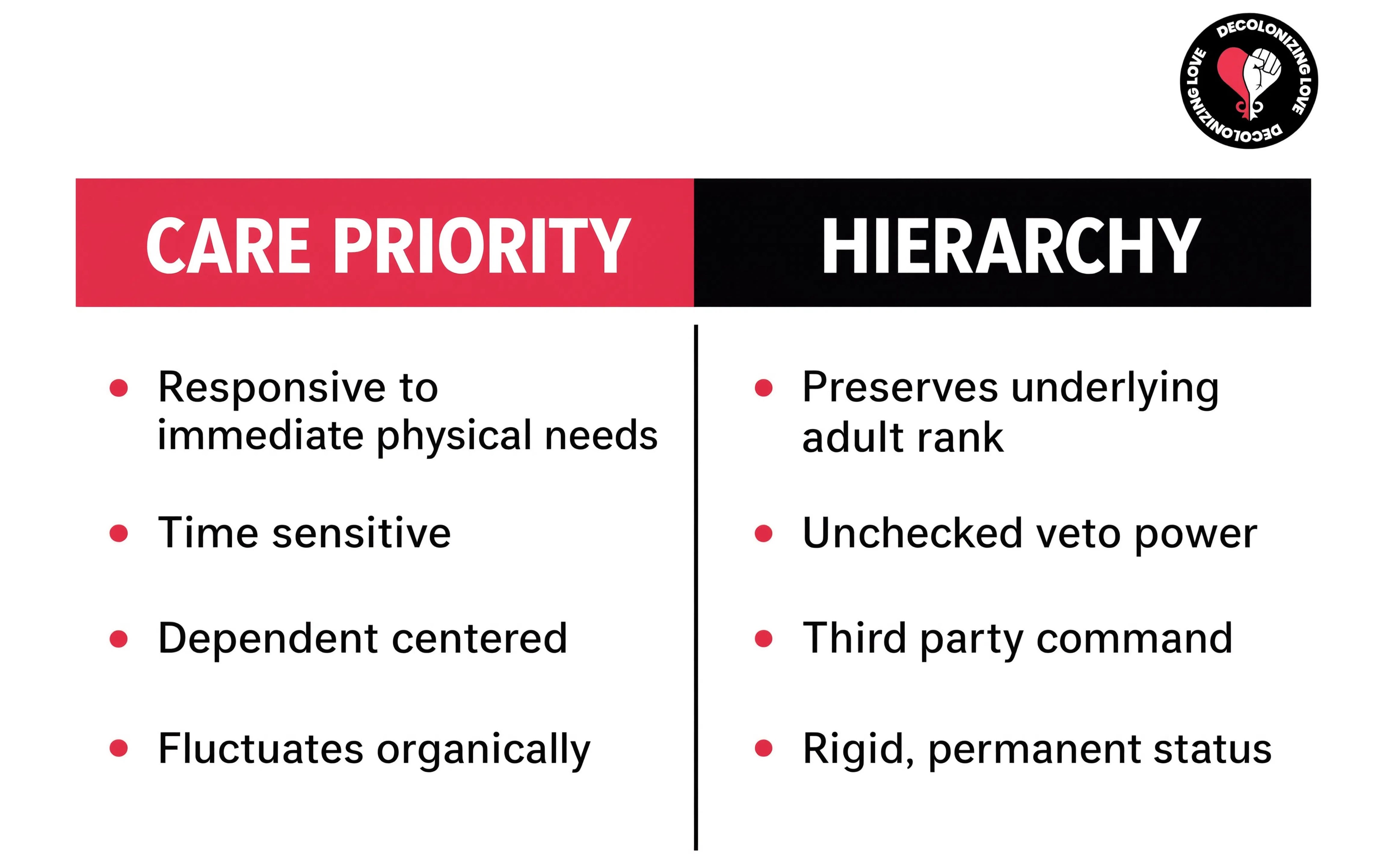
I get a variation of this comment every single time I post about how hierarchical polyamory is unethical. It’s a reaction rooted in a fundamental misunderstanding: people confuse immediate attention care needs with a relational hierarchy.
The Trigger & The Myth
Whenever I bring up egalitarian polyamory, many non-monogamous parents panic because they picture a feckless situation where a toddler’s basic needs are put on a literal voting ballot alongside a second date night. They imagine that egalitarian means everyone in a polycule and with a family will get an identical slice of time and attention, regardless of whether one person is three years old and needs their diaper changed, or thirty-three years old and capable of making their own dinner.
This reflex stems from deep seated cultural conditioning. Ever since Western social thought embraced the idea that human order requires strict ranking, we have been taught that the opposite of hierarchy is complete disorganization. But the most well balanced kids I know are my egalitarian polyamorous friends children. They even appeared in a Canadian television news overview of polyamorous families.
Yet people use kids as an emotional shield to justify rigid, unexamined couple privilege and hierarchical polyamory.
Couple privilege is what society hands to an established, recognized couple whether they ask for it or not, because our culture is built around monogamy and only recognizes a two-person relationships as valid. So you see this expressed in legal marriage, tax breaks, employer benefits plans, automatic recognition at hospitals, default standing in estates, immigration sponsorship and holiday packages priced for two like “his and hers” everything. That is privilege rooted in a social hierarchy. It is not, on its own, a relational hierarchy.
A Relational Hierarchy is the choice to take that structural advantage and wield it as power over someone else’s relationship.
A child having non negotiable needs isn’t a hierarchy, it is dependency. When a three year old gets a fever, you cancel date night because you are an adult who chose to look after a dependent human. You do not do it because the child exists at the top of a feudal pyramid. Confusing attention priority with relational hierarchy reveals how fragile and codependent our cultural views on autonomy really are. The key concept here is agency.
The full post below is for paid subscribers. Inside, we shatter the myth that having a family requires being hierarchical. Grounded in evolutionary anthropology and empirical studies on real-world egalitarian polyamorous families, we present a structured, healthy approach to coparenting without being hierarchical, complete with practical tools for your household.