Manufacturing Consent, Ignoring Conduct: The Chomsky-Epstein Connection.

Trigger warning: This essay engages with Jeffrey Epstein’s archive and includes discussion of sexual violence, as well as a personal reference to sexual assault. Please read with care and feel free to skip if you need to.
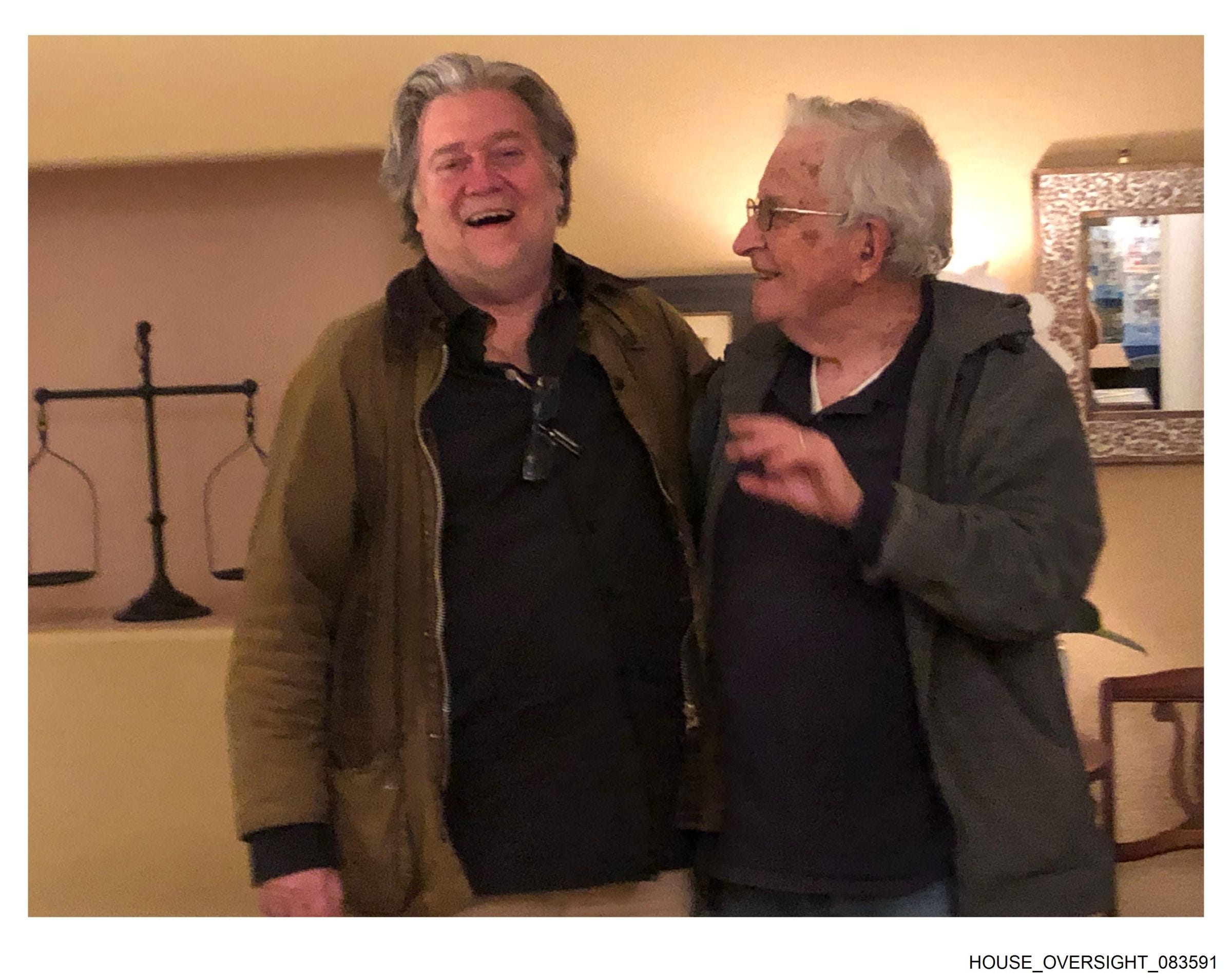
In mid-November 2025, U.S. lawmakers released more than 20,000 pages from Jeffrey Epstein’s estate, the disgraced financier and convicted sex offender who died in federal custody in 2019. The archive was a thick dossier of photos and correspondence involving prominent figures. The first image I saw from it was an image of Noam Chomsky with Steve Bannon, a former Trump strategist and right-wing media figure, and my stomach dropped.
My reaction was disbelief. Like many people encountering damaging information about figures they admire, I went straight into cognitive dissonance. I told myself it must be fake, an AI fabrication meant to stain a legacy. Chomsky is 96 years old. A severe stroke has left him unable to speak or write publicly, so he can’t respond or contextualize anything. When multiple independent outlets verified the authenticity of the photos, I did what people do to protect a belief. I started rationalizing.
He talks to everyone.
He’s debated and engaged across lines.
He’s always said you confront power by looking it in the face.
After all, he publicly debated everyone from Alan Dershowitz to skeptics of Vietnam era dissent. But even as I tried to soothe myself, I could feel something deeper stirring, about how even the people we treat as moral beacons often still move through and benefit from power networks. This hit hard because of what Chomsky has meant to me.
I first discovered Chomsky’s work as a teenager in the Netherlands in the 2000s, long after he had become one of the most cited living scholars in history. His political commentary began in the 1960s, when essays like The Responsibility of Intellectuals (1967) challenged American academics to confront the truth about the Vietnam War. By the time I picked up Hegemony or Survival (2003), Chomsky had already transformed from a pioneering linguist who revolutionized modern linguistics with his theory of universal grammar in the 1950s into an international critic of U.S. foreign policy. In that book, he argued that the average lifespan of a species is about 200,000 years and that we are roughly at that mark. He warned that humanity’s survival depends on curbing imperial power and ecological exploitation.
By the time I got to York University, Canada’s most openly leftist campus in the 2000s, his ideas were everywhere. Chomsky visited my campus in my second year to give a talk on U.S. power structures and media propaganda, carrying forward the analysis from Manufacturing Consent (1988). The event sold out, so I watched from an overflow lecture hall, but even there his intellectual charge was inspiring. Through his work, I began seeing the machinery beneath the headlines, how governments and media manufacture consent, and how the rabbit hole goes far deeper than we could imagine.
Chomsky’s work also led me to thinkers like Norman Finkelstein, his onetime protege and later a fierce critic of how political and historical narratives can be weaponized. Years later, seeing Finkelstein speak in person felt like meeting a living continuation of the Chomskyan tradition, a forensic dissection of power and propaganda. I even managed to get Finkelstein to sign the Chomsky book where I first learned of him.
The Epstein files revealed a jarring paradox: Chomsky, the man who taught me to dismantle power with intellectual precision, was entangled in its darkest corners. But he had said, almost prophetically, that no critic is truly outside the systems they critique. After the initial shock wore off, I decided to dig deeper.
As I dug into the reports, it became clear this wasn't just a brief, awkward photo-op like the one with Bannon; there is even a photo of Noam on a private plane with Epstein.
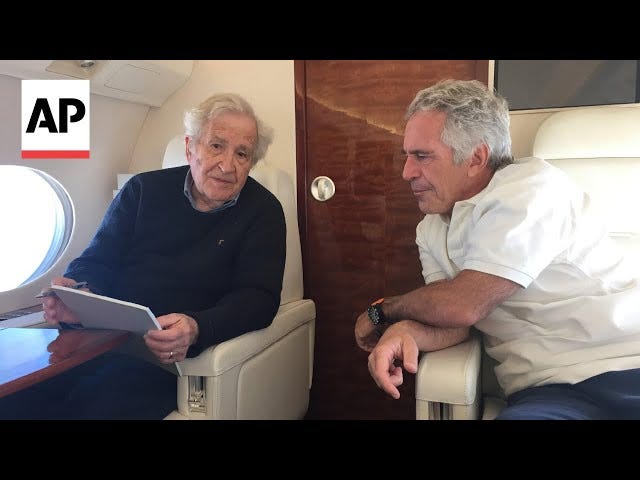
Chomsky maintained regular contact with Epstein for years after his 2008 conviction for procuring a minor for prostitution and soliciting prostitution, describing their exchanges as a “most valuable experience.” In a letter of support, Chomsky called Epstein a “valued friend” and a “regular source of intellectual exchange,” praising his boundless curiosity and easygoing nature.
This was far from an abstract critique of power from a distance. It was a personal, repeated endorsement of a man who moved in the most elite financial circles and whose crimes were already public knowledge. When later asked about his ties to Epstein, Chomsky reportedly dismissed the concern with a shrug and said it was none of your business. The refusal to acknowledge any misjudgment, any discomfort, or any moral cost, even years later, is truly telling. The same person who taught us to dissect the lies of empire treated proximity to a predator as a private matter, not a political one.
Once the blinders are off, you start rereading everything. And in that rereading, I found myself noticing other places where Chomsky’s moral clarity felt inconsistent, where he seemed unwilling to name power as bluntly. For example, I found his consistent refusal to treat Jean-Bertrand Aristide’s 2004 ousting as a straightforward U.S.-backed coup in Haiti hard to square with how sharply he could diagnose U.S. interference elsewhere.
Then there was his 2017 comment that Antifa was a major gift to the right, including the militant right, who are exuberant. He called it a minuscule fringe of the Left, argued that its actions were often wrong in principle. It’s jarring to watch a Jewish intellectual shaped by the Holocaust’s shadow, someone so attuned to imperial violence, denounce Antifa so cleanly while being far less direct about a coup against Haiti and Haiti’s right to self-determination.
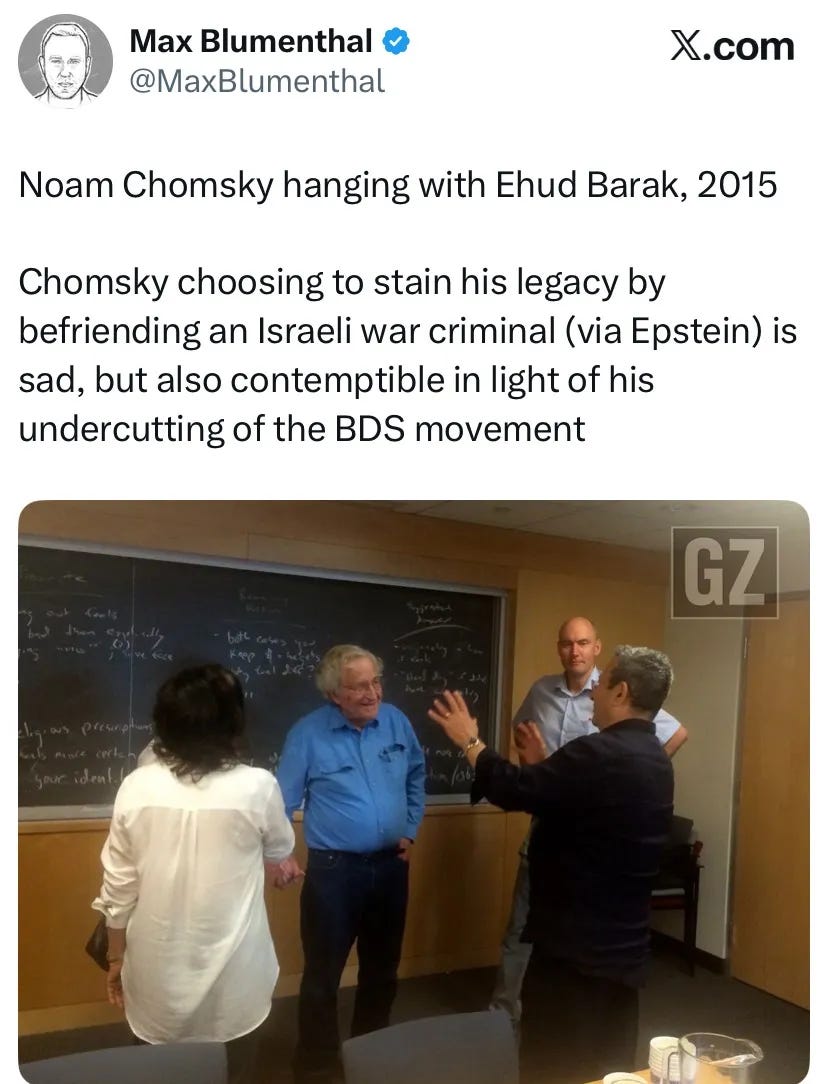
And there was more. Virginia Giuffre, who was trafficked by Jeffrey Epstein as a teenager to powerful men, named former Israeli prime minister Ehud Barak in court filings reported in 2020, among the men she said Epstein forced her to have sex with. In her memoir, she said she was violently raped by the prime minister. So it’s deeply troubling that Chomsky, through Epstein, befriended Ehud Barak.
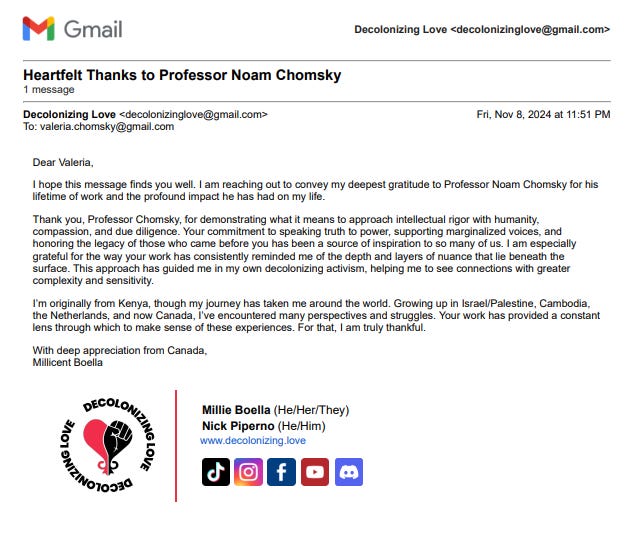
All of this landed with a particular disillusionment because almost exactly a year before the Epstein files involving Chomsky were released, I emailed him to thank him for shaping how I think about power. Part of my practice is giving my heroes their flowers before they transition. But looking back at that email now, it’s cringe.
Millennials truly get no heroes. Every year it feels like another one gets revealed as a creep or implicated in something rotten. And it took me a decade, all of my twenties, to learn how to live with that reality in the context of art.
I was sexually assaulted by a famous musician when I was 19. For years afterward, hearing his music in public could send me into a dissociative spiral. I remember feeling relieved when he got arrested, when his music got pulled from airwaves, when the public actually shunned him. But I watched friends later wrestle with their own versions of the question. What do I do with an artist I love who’s been revealed to be a rapist?
My answer to them came from a place of survivor reality: the idea that we can always “separate the art from the artist” is a luxury reserved for those who haven’t been harmed.
So here’s the hard-won wisdom I’m sharing out loud for the first time: when you blast an abuser’s work in public spaces, it’s not just a matter of taste; it’s callous. You have no idea who in that room is being forced to relive their own trauma just because you wanted to hear a specific song or see a certain film. If you want to consume that work, do it only in the privacy of your own home.
I know the emotional attachment to art created before you knew the truth is real. I know that sometimes, art is the very thing that gets us through. But we shouldn’t ask survivors to pay the price for everyone else’s “complex” appreciation of a monster.
Figuring that out retrospectively felt clearer, because art is one thing and ideology is another.
Like can we still quote Chomsky? And I’m asking that as a decolonizing activist where being anti-hierarchical is foundational. Chomsky’s analysis, especially his anti-imperialist and anti-hierarchy readings as an anarchist, has real value. It sharpens political literacy.
A follower said something under one of my first posts about losing Chomsky as a North Star, something that helped me finally locate my bearings around this.

I’ve landed on it’s okay to quote Chomsky, at least unless a survivor comes forward about direct harm he committed. Most intellectual icons were never morally spotless. Quoting him doesn’t have to mean venerating him. An idea can still shine a hard light, even if the lamp it came from was cracked. Ideas are agnostic. They don’t need to come from a saint nor require hero worship. If the analysis is true, it can walk on its own two feet.
If I could rewrite my email to Chomsky, I wouldn’t offer flowers. I’d say: thank you for teaching me, even more poignantly, how power hides in plain sight. How some people know how deep the rabbit hole goes not because they’re wizards perched intellectually above, but because they’ve had insider access to elite circles. And thank you for the reminder to be deeply wary of those who preach pacifism in the face of imperial violence.
And thank you for the hardest tie-back to Hegemony or Survival. The choice isn’t only about what empires do out there; it is indeed about us and our deepest humanity in what we do in here, and whether we’re willing to apply the same critical standard not just to our institutions, but to our icons and ourselves. If you taught me to be critical, then that critique has to hold even when it’s uncomfortable, especially when the discomfort is about you.
In African tradition, the griot is a sacred vessel, a keeper of the world's memory and the alchemy of language. You, as a master of words, were the premier word worker of our era. My African ancestors say that sort of gift is a charge, and to betray it is to invite the silence of the spirits. So it is poetic justice that a master of words who couldn't speak up against a darker power who hurt the most innocent: children, can no longer speak or write. Viewed through the spirit-eye, this is no random stroke of tragedy; it is the weight of spiritual wrath, the quiet, heavy settling of a cosmic account.