The Grief Nobody Warned You About in Polyamory

Polyamory invites us to concentrate on possibility, the feeling that life can hold more than you were taught. That is what seduces us. But polyamory teaches death in equal measure. Not the kind that stops a heartbeat, though that comes too, but the kind that moves through the living.
Grief arrives when you are no longer exclusive with your partner even if you chose this new life. It arrives when the shape of love you built a home inside, the one you dreamed so vividly you willed it into existence, evaporates, and you are standing in a future you may have not designed and do not recognize. Grief comes when your body understands before your mind does that the old life is gone.
These are small deaths. No one has taught you how to mourn them. No one will bring casseroles. And if Western culture can barely hold space for the grief it does acknowledge (funerals where you get three days off work, divorces that come with paperwork and pity, endings the law recognizes), how could it possibly know what to do with your unseeable losses? The metamour who used to feel like family. The partner who is no longer a primary but is still here, still real, still eating breakfast in your kitchen some mornings. The version of yourself who believed love looked one way, and is now gone, and who you are expected to bury without ceremony.
No ritual. No witness. For every door that opens, another one closes. Maybe you knew that. But no one told you how many doors there were in Polyamory. No one told you that you would be the one left standing in the hallway, trying to remember which rooms are yours now.
I’m a polyamory educator, but death has been my biggest teacher and one of my passions. Growing up under the violent dictatorship of President Moi in Kenya, and later in Israel and Occupied Palestine during the first Intifada and the first Gulf War, I learned early what it means to live close to death, when the sky itself seemed to learn new ways to scream. I saw dead bodies many times and had many close encounters with death myself.
The closest was when I was 18 and contracted tuberculosis from someone who had been in a Russian prison, and had an aggressive strain resistant to antibiotics. Three weeks after the initial infection started, I died briefly. Long enough to cross into a place so beautiful that no language can explain it. But I came back. My father had just died, and I could not let my family bury two of us in the same breath. So I chose this world again, and ever since, death and I have been closer. We understand each other. We are good friends.
Four years ago, cancer was taking my best friend, and I talked to her about going into the sunset. I told her not to be afraid of the strangeness. Not to be afraid when her body did what bodies do. Not to be afraid when her mind went wide and quiet, or if it splintered loud and wild. Death, I told her, is not the enemy. It is beautiful. It is honest. It will not lie to you. You will understand more than you ever have.
And that lesson lives in polyamory too: in the death of your old relationship structure, there is honesty. In the ending of exclusivity, in the transformation of a partnership, there is truth that only death can teach: the truth that nothing was ever guaranteed. The Tibetan Book of the Dead teaches this about transitions: your mind will try to grasp at familiar forms. It will try to rebuild the old world. And the invitation is to recognize the grasping without shame. To remember that clinging to attachment is what creates suffering, that everything has a season. In polyamory, you practice this constantly: letting relationship forms dissolve and reform.
I have been the last voice. The last words in someone’s ear before they crossed. Some of us are born with the blueprint to be crossing-keepers, death doulas, the ones who stand at the edge. I did not choose this work. It chose me and I said yes, because death work teaches life. It is the only thing that teaches you how to live without lying.
And grief is part of that teaching. Grief is not just something to endure or overcome. Death and grief dismantle our illusions of permanence, autonomy, and certainty. They force us to face what we would rather forget: that everything changes, and that love always leaves a mark. They invite us to reimagine identity as porous, shaped and reshaped by who and what we have loved, and who and what we have lost.
So when my polyamorous clients come to me with grief they cannot name, it makes perfect sense. Of course I know how to sit with endings that don’t have funerals. Of course I know how to help people mourn what isn’t dead but is no longer alive in the same way. I teach them what death taught me. That transitions deserve witnesses. That you can build rituals even when society won’t. That grief in polyamory is not failure, it is proof that the love mattered, that the shape of it mattered, that you are human and correctly feeling a big shift about something that was meaningful to you.
The Anatomy of Grief
Clinically, grief is the emotional and psychological response to loss. Not just death. Any loss. It can be sadness, anger, numbness, guilt, relief, and confusion all at once, like trying to carry water in your hands. But it is not only about what you lose outside of you. You die too. You lose a version of yourself. The routines that gave you structure. The roles that told you who you were. The assumptions about safety that let you sleep at night. The future you had been building in your mind like a house you would one day live in. All of it collapses. They call this secondary loss, as if secondary means smaller. It does not.
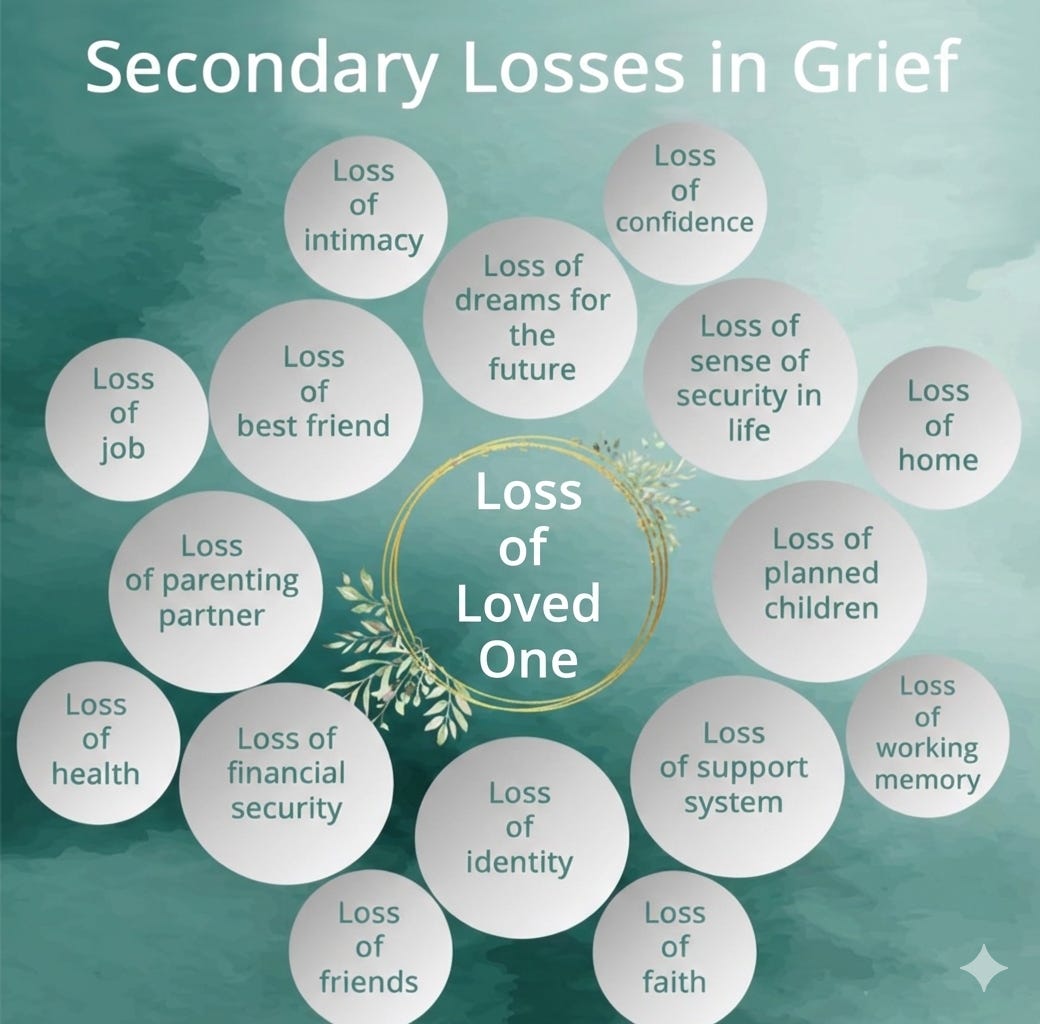
Your nervous system loses its map. You reach for old coordinates and find nothing. It is not just “I miss them.” It is “Who am I now?” It is “How do I exist in a world that took this from me without asking?” That is why you go looking for the old you, even though she is gone. You need her. She is all you have ever known. You bargain with a past that will not answer. And it comes in waves because your body can only process change at the speed it can, not at the speed culture demands, not at the speed capitalism needs you functional.
And we are all in grief.
Since 2020, we have been living inside collective grief: the millions who died due to the COVID-19 pandemic, the normalization of mass death on our screens, American fascism, the genocide in Gaza streamed through our phones that we watch and watch and can do nothing to stop. We are also grieving futures, safety, and coherence in a world where we do not have economic or political stability and where even the weather due to climate change is not predictable next year.
Colonial culture is a death cult, and it teaches us to grieve alone, grieve quickly, grieve quietly, grieve productively.
But grief is supposed to be ugly and messy. To decolonize grief is to treat mourning as truth-telling. As refusal. A refusal to let erasure finish the job. A refusal to pretend the dead did not matter, that the loss was not real, that we should be over it by now. It is a choice to re-root ourselves in relationship, even when what we loved has changed form, even when the future we imagined will never arrive. We have to let the grief move through us, and stop apologizing for the storm.
Of Holy Litanies, Ceremony and Ritual
Rituals matter because grief is energy looking for somewhere to go. It is a river that will carve its own path if you do not give it one. Cultures knew this. Which is why they built grief containers so people would not drown alone. Across the world, rituals give that energy shape and direction. They say: here is how you hold what cannot be held. Here is how you survive what feels unsurvivable.
In many global cultures, mourning is communal, physical, rhythmic. There is choreography. There are witnesses. There is song, drumming, wailing, silence, fire, food, prayer. People stay. They do not send a text and disappear. They eat together. They sit with you in the bewilderment. They carry you through the days when your body has not yet caught up to what your mind knows: the person is gone. The thing is over. The world has changed.
Rituals are technology. Ancestral technologies of regulation and reweaving. They move grief through the body and through the community so it does not calcify into numbness, bitterness, hypercontrol, or self-abandonment. Without ritual, grief becomes static. It turns inward. It grows heavy. It becomes the thing you cannot name, the weight you carry but never set down. The West treats grief like a temporary mood to manage privately, like something embarrassing you should handle alone in your apartment with the lights off. But when ritual is missing, grief does not disappear. You just become lonely even in crowded rooms. Unprocessed endings keep trailing you like ghosts you cannot see but can always feel.
In Māori tangihanga, mourning unfolds over days through song, storytelling, and collective lament. In Mexico’s annual Día de los Muertos, families build altars and share food with the dead, affirming that love transcends separation. In the Jewish tradition of shiva, the community visits for a week of presence and listening, reinforcing that grief is not solitary, it is a gathering. In Japan’s Obon festival, lanterns and dance welcome ancestral spirits home before releasing them back to the unseen world. Every ritual, no matter the geography, says the same thing: grief belongs in motion. Grief belongs in relationship.

Even the end of relationships can be given ritual. Some Indigenous groups hold cleansing rites to mark the end of a partnership, releasing both people from shared energies so they can walk forward without dragging the past behind them. In Thailand, Buddhist monks offer prayers for peace and renewal after a divorce. In parts of South Africa, family elders gather to symbolically “return” the bride and groom to their original families in a spirit of respect, acknowledgment, closure.
Polyamory makes the need for ritual more urgent because it creates losses the world does not know how to name. A dynamic shift in ways traditional language cannot hold. A love mattered, but it does not fit on any form, in any ceremony, under any law. That gap creates a kind of cognitive void that feels like deeper loss: a blank space where your mind keeps reaching for meaning and finds nothing.
These griefs become invisible because you do not have the words, and invisible grief is the loneliest kind. Rituals are one of life’s oldest continuities for processing what isn’t tangible anymore. They give shape to the unnameable, and a way to move what would otherwise stay stuck inside you.
So what does that look like in practice? Below are some of the most common forms of grief in polyamory, and ways to process them through ritual.