
How did the polyamory community drift into being so unempathetic?

From Avoiding the Dismantling of Couple Privilege to Egalitarianism
The modern polyamory movement spent its early years tiptoeing around couple fragility, bending language and practice to cushion people opening an existing relationship. The word “polyamory” itself was popularized through the libertarian magazine Green Egg by Morning Glory Zell, and a lot of mainstream advice back then normalized hierarchy, vetoes, and “probationary” secondaries. It was humiliating, and it stripped power from anyone not in the primary relationship. Even in the late ’80s and ’90s there were plenty of non-monogamists calling that out and arguing for egalitarian practice, but the term “egalitarian polyamory” didn’t really catch fire until the 2000s. By the time I entered the Toronto scene in 2017, egalitarian polyamory was the default in most spaces I moved through.
The 2025 Backlash: Freedom without Empathy
Fast forward to 2025 and we’ve swung hard in another direction. I’m seeing takes that any mutually agreed transparency, like checking in before sex with someone new or before deepening an emotional bond, is “controlling.” That’s odd to me, because agreements aren’t rules; they’re consent tools.
I’m also seeing this lack of empathy show up in other conversations. Just today, I posted responding to people asking how to cope with the shame of hearing their partners have sex with others. Instead of compassion, some replies dismissed the question entirely, saying it’s “just sound” and people should “grow up.” To me, that response misses the point. Shame is real, and people deserve tools to work through it, not ridicule for even having the feeling.

Four Agreement and Boundary Frameworks
As the most-followed polyamory educator in the world and a coach, I clocked early in my work that there are distinct camps in how polyamorists structure communication, agreements, and boundaries. From my experience, there are three workable orientations and one red flag.
Transparency prioritizing. That’s where I fall. We value clear, proactive sharing because transparency creates safety. It’s not about surveillance, it’s about informed consent and trust that’s built, not assumed.
Autonomy prioritizing. Freedom and privacy come first. Boundaries are minimal by design, and “don’t ask, don’t tell” can be a feature, not a bug. For some, secrecy feels safer because of past control and punishment. They need time to process and to share when they feel safe.
Adaptive connecting. These folks tune to the relationship at hand, deepening transparency when needed and offering privacy when needed, without abandoning their own center. They’re bridge builders.
One-sided polyamory. These are the people who want full transparency from their partners while fiercely guarding their own privacy and freedom. That’s not a style, that’s a control pattern.
What My Audience Revealed
Every time I post on this subject my Instagram comments are full of people saying, “that’s the language I’ve been looking for.” Personally, I’m transparency prioritizing. Most of my partners have been adaptive connecting, and that’s been beautiful. I dated one autonomy prioritizing person and it was a mess, fundamental incompatibility. He cheated because he didn’t want to tell me about his desires beforehand. Whenever I name my agreements publicly, the autonomy prioritizers get heated, but my DMs fill with relief from transparency prioritizers who feel seen.
Out of curiosity, I polled my audience. The loudest voices online often sound autonomy first, so I expected that to win. Instead, most respondents identified as transparency prioritizing, then adaptive, and autonomy prioritizing came last.
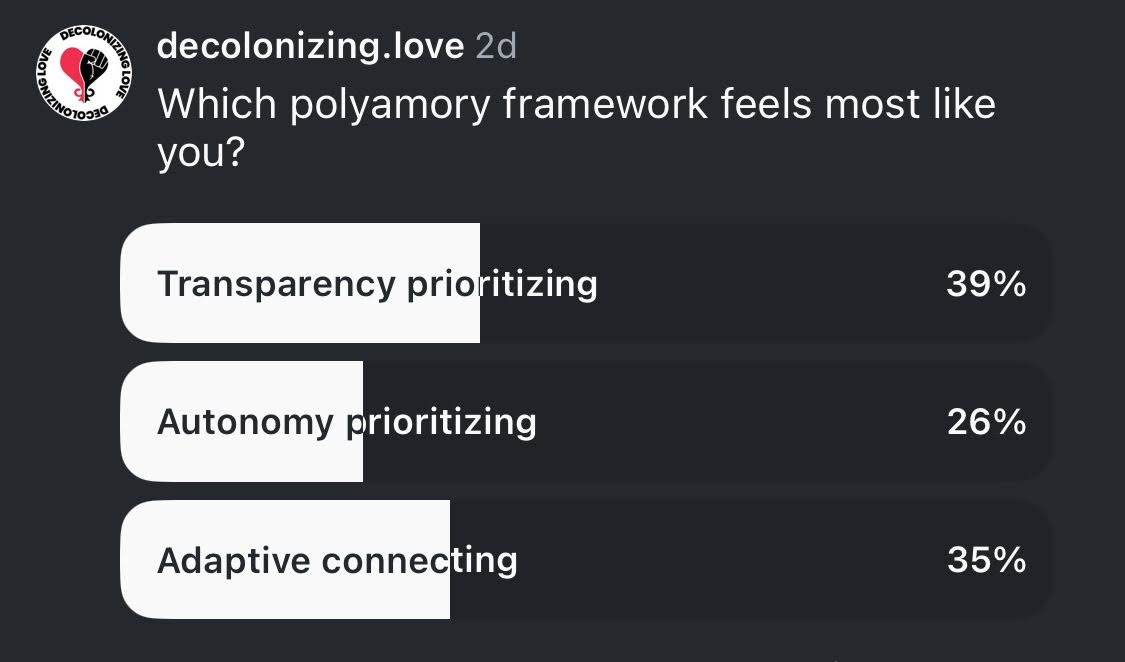
Even one of my followers was surprised at the poll outcome, given the dominant poly online culture.
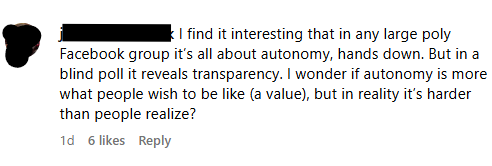
The discrepancy tells me something about who speaks the most versus who’s actually in the room.
The Pendulum Swing
My working theory is that autonomy-prioritizing polyamorists often take up more space in the discourse because “freedom” language maps neatly onto polyamory’s liberation frame. When autonomy is centered, transparency-prioritizers can internalize shame, wondering if they’re “too much” for needing details and agreements. That imbalance doesn’t just shape conversations, it’s shaped polyamory culture.
As a community we pendulum swung from babysitting fragile hierarchical couples to pretending empathy itself is control. There’s a middle. My work has always been rigorously anti-hierarchy, and still I try to welcome people transitioning out of hierarchy by giving them sturdier ways to feel secure, ways that don’t trample anyone else’s consent or agency. That’s the decolonial project for me: replacing domination with relational accountability.
So here’s where I land. Transparency agreements are not bondage, they are boundaries. They’re how I communicate, “this is the kind of container in which I love well.” If that’s not your container, cool, we’re just not a match. Autonomy-first polyamorists deserve relationships where their need for privacy isn’t shamed. Transparency-first polyamorists deserve relationships where information isn’t pathologized. Adaptive polyamorists deserve partners who can appreciate their range without exploiting it.
If we want less chaos and more care, let’s stop flattening every boundary into “control,” and let’s stop shaming privacy as “dishonesty.” Call your orientation what it is, name your needs plainly, and choose each other accordingly. That’s not control, that’s consent culture. It’s also how we avoid recreating colonial scripts of power over one another while we claim to be liberated.