
Decolonizing Therapy Also Means Ending the Pathologizing of Non-Monogamy

I had a polyamorous client who came to me for coaching after a therapist flat-out refused to take her on. She suspected it was because, during intake, she said her main focus was working through challenges in her polyamory practice. This is what discrimination against non-monogamists in therapy looks like. Sometimes it’s blatant: therapists dismissing polyamory as unserious or unworthy of support. Other times it’s quieter but just as damaging: therapists who say they’re “fine” with polyamory but never seek training nor engage with our communities. One in five non-monogamous clients report their therapist failed to learn about non-monogamy (Conley et al., 2012). That often leaves clients doing the emotional labor of educating their own therapist while being treated like some intriguing study from an alternative world. This doesn’t just compound stigma; it reenacts it. And this traces back to therapy’s colonial roots, not as a neutral science, but as both a study of the ‘peculiar’ and a technology of governance: to reproduce normativity.
Psychotherapy emerged in 19th-century Europe, at the height of colonial expansion and industrialization. The enclosure movement had already forced peasants off the commons, privatizing land and dismantling not just subsistence economies but also networks of communal care. Where mental illness had once been addressed within community, the rise of the industrial city created new conditions: mass poverty, dislocation, and the despair of capitalist disconnection.

But a society built on industrial productivity required disciplined, “normal” subjects. Those who did not fit in were increasingly cast as social problems. The asylum expanded as a way to contain them, and psychotherapy developed alongside it as a science of classification less to heal than to police the boundaries of normality. This same logic extended into sexuality. The 19th century was marked by a culture of repression, where sex for connection, pleasure, or passion was cast as wasteful. And what wasn’t useful to capital was often pathologized. Within this framework, sex was reduced to reproduction inside the nuclear family: functional, heteronormative, and centered on the man’s orgasm as the only outcome that mattered, because male orgasms were necessary for the production of children, while women’s pleasure was deemed irrelevant. The only permissible form of sex was the kind that produced the next generation of workers and citizens for the state. Everything else, any expression of desire or intimacy outside this narrow function, was cast as deviance. It’s no accident that psychotherapy’s early focus was on “hysteria,” where women’s needs for sexual pleasure were medicalized as signs of illness.
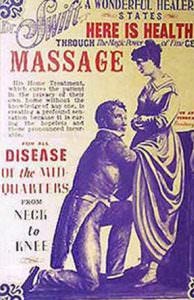
Victorian advertisment showing a doctor treating woman’s ‘hysteria’ by ‘pelvic massage’.
And this isn’t ancient history. Homosexuality was listed in the DSM until 1973, with “ego-dystonic homosexuality” lingering until 1987. That legacy shows up today in how sexuality is still sidelined in therapy training; sexology isn’t part of most programs, even for couple counselors.
Because therapy training is built on colonial norms rather than the full spectrum of human experience and sexuality, non-monogamy and other non-traditional sexualities are almost entirely left out. Even when they aren’t overtly pathologized in textbooks, the framework still sends the same message: if it isn’t normative, it’s a problem. The result is that non-monogamous clients come up against a therapeutic culture that has only ever studied monogamy as the assumed default.
How this shows up for non-monogamous clients is that instead of being offered tools for navigating the realities of polyamory, they’re often steered back toward monogamous norms.
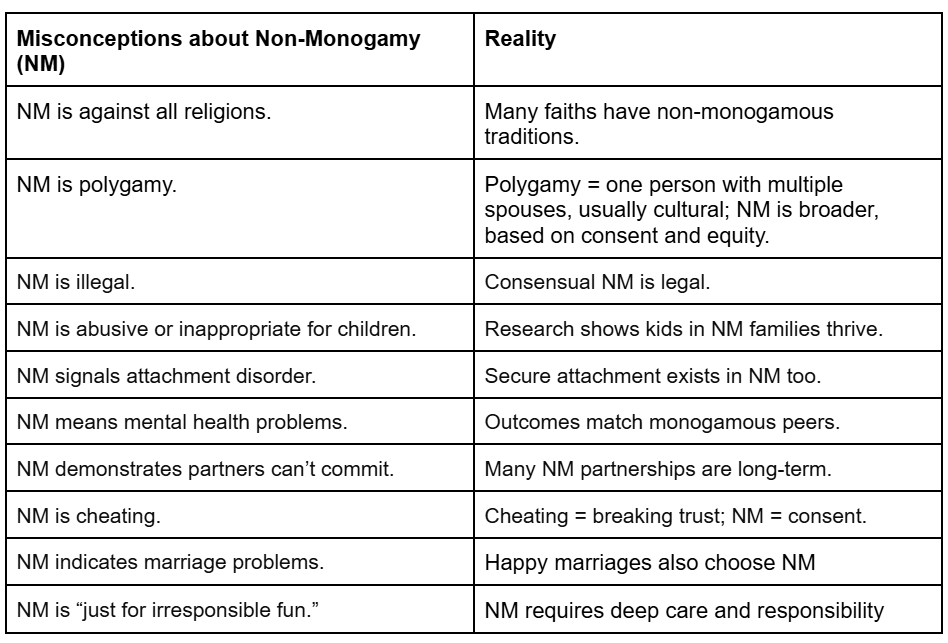
These misconceptions don’t just exist in public discourse, they shape the therapy room itself. For example, a client who names jealousy or primal panic may be told: “maybe this just means you’re not cut out for polyamory, maybe monogamy would be better for you.” Jealousy is a normal human experience, polyamorous people feel it too. The difference is in how it’s understood and worked with. In polyamory, jealousy can become a tool for shadow work, helping people confront scarcity mindsets and old wounds. But instead of framing jealousy as an individual deficit, a decolonial lens would recognize it as a relational pattern shaped by culture, something produced by systems of ownership, comparison, and hierarchy, not just by personal “failure.” When it comes to attachment, therapists default to models built on hierarchical, mono-centric assumptions. where one “primary partner” is the center of gravity. This framework creates real inequities in polycules, yet it’s rarely questioned in clinical settings.
And here’s the deeper blind spot: most therapists, and their clients, come from middle- or upper-class backgrounds. The training required to even become a therapist is prohibitively costly, and the ongoing fees to stay licensed and accredited keep those barriers in place. Add to that the fact that therapy itself is expensive and often inaccessible, and the result is a profession that largely reproduces its own class exclusivity. Challenging hierarchy in relationships also means challenging hierarchy in class and privilege, and many therapists avoid going there, because it destabilizes the very structures that sustain their profession, their credentials, and their wallets.
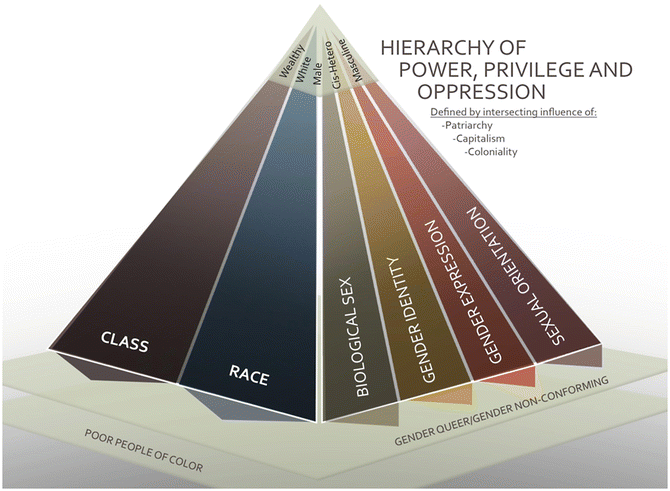
Decolonizing therapy means challenging hierarchy and asking how security can be built without clinging to privileges like couple privilege, class privilege, racial privilege and other forms of dominance. Colonialism being a dominator culture. Dismantling privilege is difficult work, and therapists must first learn to sit with their own discomfort if they are to guide clients in doing the same. This requires ongoing self-reflection, such as developing power literacy. Have I mapped the identity-based power dynamics and structural stressors at play? And conducting a bias audit: where might my values, experiences, or training lead me to pathologize certain relationship structures?
This is especially important when working with non-white and non-Western clients, whose family structures and sexualities have been disproportionately pathologized. One of the first moves of colonial powers was to outlaw polygamy and enforce Western monogamous marriage as a precondition for land ownership. Those who refused were not only dispossessed of their land but also had their children abducted and placed in residential and boarding schools across the colonies. There, they were subjected to gendered education that dictated how “civilized” men and women were supposed to perform relationality, according to European norms, not their own traditions.
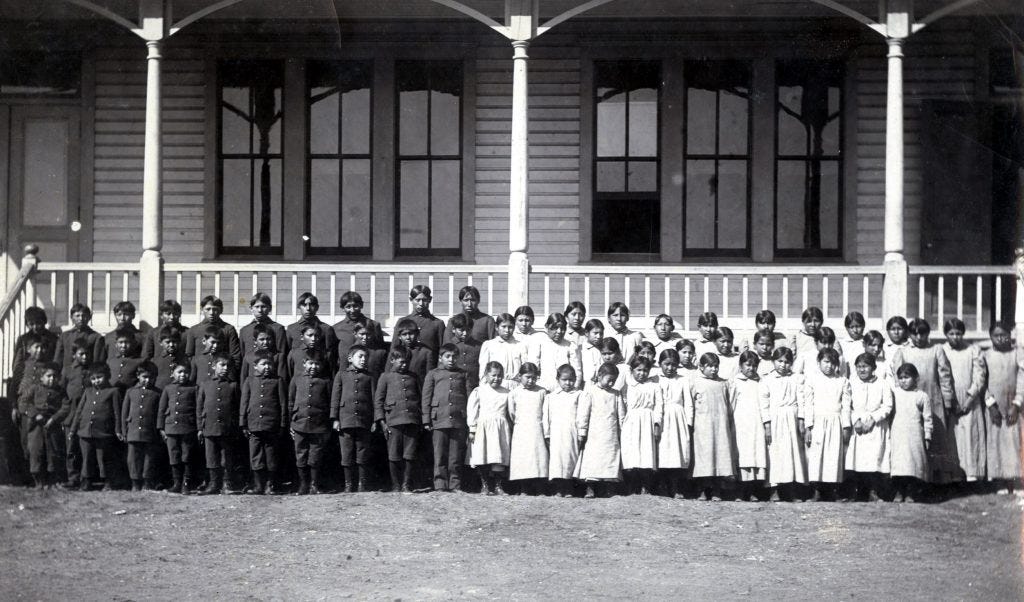
Native American Boarding School in Oklahoma, which was previously a U.S. Army barracks.
In other words colonial powers restructured intimacy itself. By criminalizing Indigenous and non-Western kinship systems and replacing them with Western monogamous marriage, they laid the groundwork for the nuclear family to be upheld as the only “proper” social unit. It has been the building block of empire: the site where future citizens are socialized, where parental domination introduces children into hierarchical, dominator culture, and where care is privatized, especially onto women.

To decolonize is to challenge all of this. Many Indigenous cultures offer a radically different model: children are granted far greater autonomy, seen as independent beings with their own guidance, free to leave or return to parental care as they choose. Care is not privatized but communal, woven into extended kin networks. And sexuality, gender and marriages are fluid.
These contrasting models of family and care reveal that what Western culture treats as “natural” is, in fact, historically constructed and politically enforced. Just as the nuclear family was designed to serve empire, so too was monogamy positioned as the unquestioned relational norm. Before European expansion, only about a quarter of world societies practiced social monogamy. It is not humanity’s “natural” disposition. Today, it’s estimated that over 20% of U.S. adults have engaged in some form of consensual non‐monogamy (Haupert et al., 2016). Around 4–5% of Americans identify as polyamorous (IFLScience, 2021) and surveys suggest that nearly half of Gen Z and millennials now say their ideal relationship is non-monogamous (YouGov data).
What this means is that more and more therapists will be seeing non-monogamous clients. They can either dismiss them, reproducing harm by pathologizing non-monogamy and driving people away from care, or they can choose to decolonize. Decolonizing one’s practice means interrogating the colonial relationship norms baked into psychotherapy from its inception and refusing to let therapy be weaponized as a tool of compulsory monogamy culture. Before therapy was professionalized and regulated as “science,” mental healing was rooted in spiritual practices and community.

A return to a pre-colonial and Indigenous understanding, where mental healing is grounded in relationality and embraces the full spectrum of human experience, would be far more powerful than the current model, which too often operates as an arm of social control.
If this piece resonates, share it with someone who needs to hear it. And if you want to keep exploring how love, therapy, and liberation intersect, subscribe so you don’t miss the next essay.
Written by Millie Boella of Decolonizing Love, and published in collaboration with Pat Radical Therapist.