The Language of Power Is Vagueness (Part 1)

“Who coined the word polyamory?” a Ghanaian hairstylist once asked me on set, as we talked about our lives outside film, mine being a polyamory educator working from a decolonial lens.
I admitted that the term itself was coined in the late 1980s by an American white woman, Morning Glory Zell‑Ravenheart, in a libertarian magazine called Green Egg.
“So how can something coined by a white, problematic woman be decolonial?” she asked. “What does polyamory have to do with us Africans?”
I told her, “Absolutely, the word ‘polyamory’ is Western. But the practice predates it by millennia. It’s like babywearing, something we’ve always done, something we were once shamed for, but that Westerners now celebrate as if they invented it. Western language didn’t create our ways of care or love and so forth; it just named them late and claimed discovery. They Columbus shit! You know this.”
She laughed.
Though non-monogamy predates European colonization across cultures, the modern polyamory community is still white, Western and you can tell by its words.
I started my polyamory community organizing in Toronto, Canada in 2017 before going international in 2021. I call Toronto the passive-aggressive mecca of the world, the capital of polite avoidance. It’s the land of British Loyalists who fled here during the American Revolution, a place built for Anglophones to avoid talking about inequity. Here, people are uncomfortable with confrontation; they speak in roundabout ways. I’ve literally watched people run from confrontation. You’re expected to guess what others mean, to centre their discomfort, to soften your truth, because in Toronto, using direct words is often considered violent. And that’s exactly how power wins. Because if naming something precisely is framed as aggressive, then the status quo gets to rest easy. It only has to wait for your tone to be policed. This is how colonial politeness works: it teaches people to fear being “rude” more than being complicit.
So it came as no surprise when a clip crossed my feed of a white Toronto therapist and polyamory educator performing verbal gymnastics to avoid naming power for what it is. It’s part of a broader pattern: the polyamory community too often reproduces a kind of colonial fragility, the reflex to dissolve critique the moment it touches power in a real way.
And what does colonial fragility sound like when it talks about power? It sounds like Marla Schreiber:
Only someone deeply invested in their own comfort could claim to be “over” talking about hierarchies, as if we’re not exhausted from living under the weight of them.
How do you even talk about equity without talking about hierarchy?
You can’t. It’s an oxymoron.
But that’s the white paradox: liberalism wants liberation without disruption.
When white voices in polyamory say they’re “tired” of hearing about hierarchy,
it’s not because the work is done. It’s because hierarchy is the scaffolding, the air they breathe, the oxygen that sustains whiteness and Western empire, the conditioning that shapes their white, fragile therapy clients.
And when that air thickens with the tension of a reckoning? They don’t confront it, they diffuse it. They reduce it to a soft, vague “H.”
Language however is the medium through which justice breathes. When we refuse to name power, we suffocate justice, and ourselves.
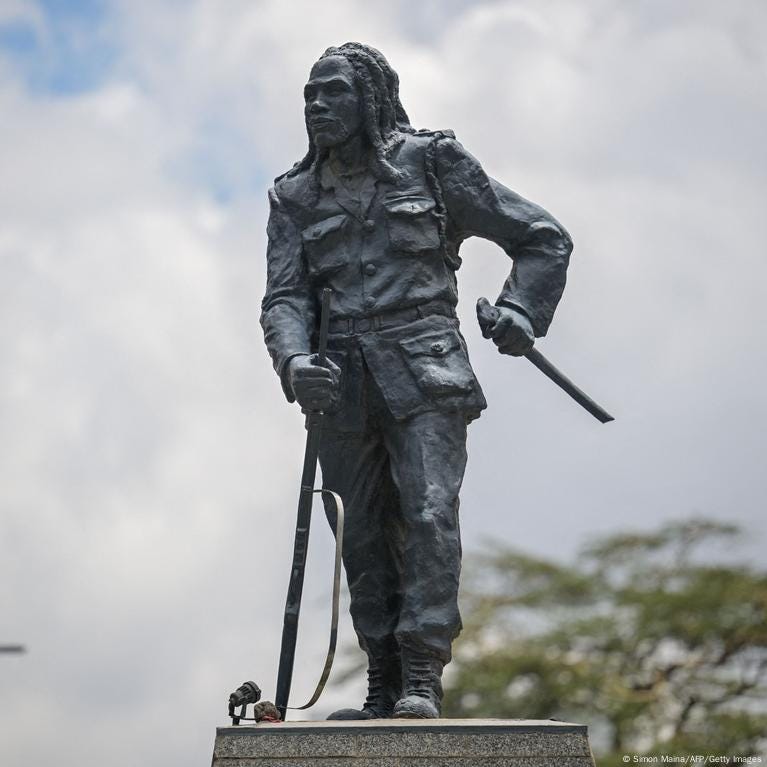
I am not a liberal. I am not an anglophone. I am a multitude of things and one of them is a decolonizing artivist, recently honored by a family member of Dedan Kimathi, my Kikuyu tribe’s freedom fighter and a hero of Kenya’s independence struggle against the British.
I am also a writer. Words are the tools of my trade and the terrain of my resistance.
I am polyamorous because polyamory resists state-sanctioned love. It allows us to live in integrity with our natural orientations toward love and desire. But you can’t claim integrity without precision, without being principled. Liberation language and ethics both demand it.
The late Ngũgĩ wa Thiong’o, a Nobel Prize nominee known for his groundbreaking work on colonialism and language, personally reached out to support my theorization on language.
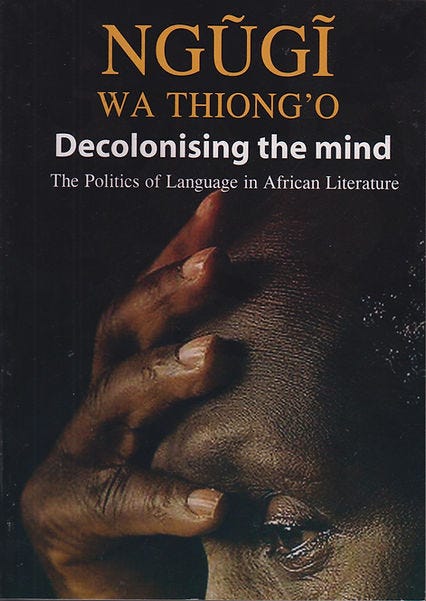
Marla’s insistence that we avoid the word “hierarchy” because it has multiple meanings is a textbook example of what Ngũgĩ wa Thiong’o names in Decolonizing the Mind: the elite tactic of claiming “confusion” when colonial structures are being challenged. By framing hierarchy as too messy or imprecise, they sidestep the political clarity it demands and protects the very systems of power it exposes.
So I say this: reclaiming our power begins with refusing to soften our language for colonial comfort.
There is no equity without naming systems of power and how they function. Hierarchy is how oppression organizes.
It’s hierarchy, not the “H-word.”
We say it fully. We say it clearly. We say it until it cracks.
Hierarchy.
If this piece stirred something in you, if it helped name what you’ve felt but couldn’t yet put into words, share it with someone unlearning power dynamics or exploring polyamory through a decolonial lens.